
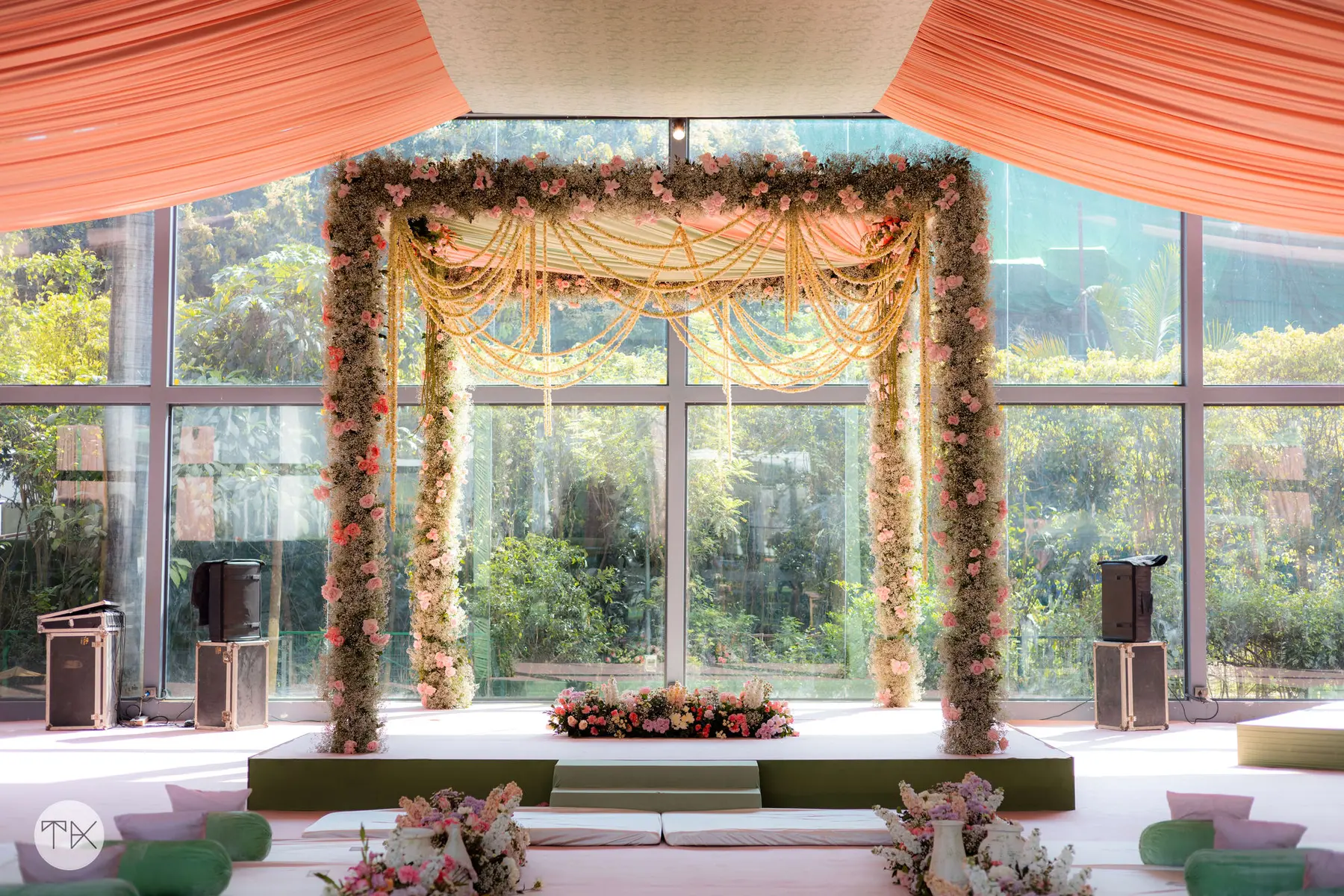
Sustainability in wedding design is often reduced to a single visual instruction: remove real flowers. It sounds decisive, photographs well as a statement and ignores most of the system that creates the event.
A flower grown close to the venue, used at its natural scale and composted responsibly can carry a different footprint from an imported artificial installation manufactured for one brief trend. Equally, abundance without thought is not made responsible merely because the material is natural.
For us, the useful questions begin earlier. What already exists at the venue? Can furniture, vessels, frames and textiles return to inventory? Can one strong spatial gesture replace several weaker ones? Which materials can travel efficiently, and which elements can be made locally?
The most sustainable decision is often good editing. A room does not need detail in every direction. Leaving architecture visible, working with the landscape and choosing fewer, better moments can reduce material while giving the design more confidence.
Real flowers still have a place. They carry scent, movement and cultural meaning that imitation cannot always reproduce. The responsibility is in how they are sourced, supported, installed and handled after the celebration—not in pretending that one universal material rule fits every wedding.
A considered celebration is not an aesthetic category. It is a chain of decisions across design, production, transport, labour, reuse and waste. That chain deserves more imagination than a ban.
See A Green Wedding Affair ↗